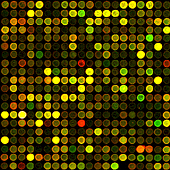
The problem is complicated if sequences are to be chosen such that they will properly hybridize to a group (e.g. a complete family of organisms), but not to any organism from a different group.
We present an efficient algorithm for the array probe selection problem. Melting temperatures and free energy for each possible sequence-probe interaction are calculated using an extended nearest neighbor model, allowing for mismatches. Model parameters can easily be adapted when new parameters are published, and alternatively parameters for DNA or RNA assays can be used. Hairpins, bulge loops and other secondary structure can also be considered.
The algorithm can easily be modified to select family-specific probes.
Data:")?>
The following files show sample data for the HIV-1 subtypes as referred to in the published paper.
HIV1.FASTA Fasta format file containing the HIV1 subtypes used.
HIV1.PRB Oligo probes selected by the algorithm
Contact:")?>Lars Kaderali
kaderali@zpr.uni-koeln.de
Download")?>
GCB 2000 Poster (PS GZIP)
GCB 2000 Poster Abstract (PS)
Diploma Thesis (Fulltext) PS GZIP
Paper (PDF), published in Bioinformatics 2002; 18(10):1340-9, (c) Oxford University Press.
ISMB 2001 Poster (EPS)